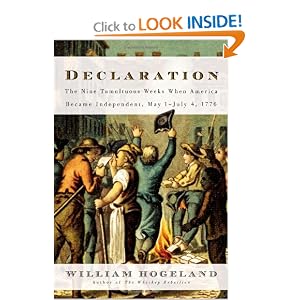
It's not about the tawdry and illicit actions of the men involved in the politics, although there was some alluding to Ben Franklin's escapades in Europe. But this book is about the manipulations, compromises and confrontations that played out as a few scores of men in the Continental Congress and colonial legislatures tried to guide thirteen disparate colonies through a tumultuous time.
You probably have a view of those efforts similar to mine. Discussions about the Founding Fathers and how they made it happen have always seemed to spring from a pretty consistent picture. The prevailing understanding seems to be something along the lines of it involving a lot of heated discussion and deliberations between and among men who were working toward the same cause. Those heated discussions were nevertheless civilized and aboveboard. And American independence was always a foregone conclusion.
Riiiggghhhttt!
If Mr. Hogeland is to be believed (and he has some pretty sturdy credentials and sources) nothing could be further from the truth.
For one thing, to a large extent, the entire independence movement was orchestrated almost single handed by Samuel Adams. Not John Adams, who is the Adams who springs to mind most readily. And when I say orchestrated that's what I mean. Without Sam Adams stirring the pot, we might still be bowing to the Queen. Sam worked all the angles. He held a seat in the Continental Congress and he schemed behind the scenes with rowdy groups (known as mobs, even today). He made alliances with anyone he thought would help him move the matter along.
In the process, elections were rigged, voters were disenfranchised and dissenters and opponents were strong-armed and intimidated. The elected legislature of one colony was essentially overthrown by his mechanizations.
Throughout the entire account of the times, American independence was never a given. It was a rough and tumble, knock down and drag out affair. When independence was finally voted for, it still almost didn't happen. And if it had been delayed just a few days, reconciliation with Britain might still have carried the day. Within a few days a peace envoy from London arrived with a broad mandate and desire to find a way to bring the colonies back into the British family.
One final note that I had to chuckle at; a big issue of the day was illegal immigration. It seems that a lot of "Dutch" (Germans) had come into the region without being invited or welcomed. They were using services and taking jobs that most citizens felt should be reserved for those who were legally in the country. Whether they should be allowed to vote was a question that both divided and united different elements of the campaign. In areas where the Dutch were seen to favor one side of an issue, they would be given the vote. If they were opposed they might not be allowed to vote. One side of the fight might be opposed to letting them vote, but then would fight to get them included in the vote because of their perceived bias as a group.
Does any of this sound familiar?
You probably have a view of those efforts similar to mine. Discussions about the Founding Fathers and how they made it happen have always seemed to spring from a pretty consistent picture. The prevailing understanding seems to be something along the lines of it involving a lot of heated discussion and deliberations between and among men who were working toward the same cause. Those heated discussions were nevertheless civilized and aboveboard. And American independence was always a foregone conclusion.
Riiiggghhhttt!
If Mr. Hogeland is to be believed (and he has some pretty sturdy credentials and sources) nothing could be further from the truth.
For one thing, to a large extent, the entire independence movement was orchestrated almost single handed by Samuel Adams. Not John Adams, who is the Adams who springs to mind most readily. And when I say orchestrated that's what I mean. Without Sam Adams stirring the pot, we might still be bowing to the Queen. Sam worked all the angles. He held a seat in the Continental Congress and he schemed behind the scenes with rowdy groups (known as mobs, even today). He made alliances with anyone he thought would help him move the matter along.
In the process, elections were rigged, voters were disenfranchised and dissenters and opponents were strong-armed and intimidated. The elected legislature of one colony was essentially overthrown by his mechanizations.
Throughout the entire account of the times, American independence was never a given. It was a rough and tumble, knock down and drag out affair. When independence was finally voted for, it still almost didn't happen. And if it had been delayed just a few days, reconciliation with Britain might still have carried the day. Within a few days a peace envoy from London arrived with a broad mandate and desire to find a way to bring the colonies back into the British family.
One final note that I had to chuckle at; a big issue of the day was illegal immigration. It seems that a lot of "Dutch" (Germans) had come into the region without being invited or welcomed. They were using services and taking jobs that most citizens felt should be reserved for those who were legally in the country. Whether they should be allowed to vote was a question that both divided and united different elements of the campaign. In areas where the Dutch were seen to favor one side of an issue, they would be given the vote. If they were opposed they might not be allowed to vote. One side of the fight might be opposed to letting them vote, but then would fight to get them included in the vote because of their perceived bias as a group.
Does any of this sound familiar?


No comments:
Post a Comment